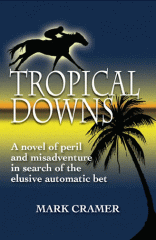
Have you ever been to Bolivia?
Do you even know where Bolivia is?
Mark Cramer, ever and
first the died-in-the-wool horseplayer and on a different level
author, world traveler and jazz pianist, has been to Bolivia. Not
only did he live there but he has chosen it as the site of his
latest handicapping discourse-come-novel. The subtitle calls it one
“of peril and misadventure in search of the elusive automatic bet”.
He has effectively bridged the
divide between these varied pursuits to make this latest literary
venture a readable, fast-moving tale of intrigue, mystery and
murder. His racing fans will not be disappointed with the direction
that his handicapping exploits take them either. The fact that my
spouse has quickly read most of the book with neither question nor
complaint is a certain testament to a job well done.
Bolivia is a landlocked South
American country bordering Brazil on its north and east, Paraguay,
Argentina and Chile to its South and Peru, which lies between it and
the Pacific Ocean on the west.
In the telling of his tale,
Cramer details the country’s internal dispute between landed gentry
and agrarian reformers. He describes the splendid panorama with its
scenic mountains, glaciers and neighboring gorges. He speaks to its
interesting biological diversity and its unexplored hinterland and
makes it feel like a place to visit should you like to explore out
of the way natural locales. To enter or depart from La Paz by air,
one of Bolivia’s major cities and the site of the world’s highest
commercial airport, you fly up to land and down when you take off.
Cramer tells the story in
first person through Matt Bosch, the handicapper who searches out
the automatic bet; he now finds himself in a country without a race
track when his wife Sonia accepts a five-year stint working for the
Marianelas. He was going to work as a journalist and perhaps a
part-time jazz pianist; there is even a late-night club in La Paz
named ‘Thelonius’. Any horse playing he does will have to be from
afar and with the help of his friends back in America. And in the
days before easy internet access to past performances, this required
relatively simple approaches. Where it comes to creativity in
handicapping, Mark Cramer must be close by.
Matt Bosch meets up with
Panama Slim on a visit to Saratoga; he is a somewhat nefarious
individual with varied and questionable interests, one of which is
to develop a race track in Bolivia. In order to accomplish this,
earn $100K, and perhaps a job running the new race track, Bosch must
meet and secure a deal with a member of the local gentry, Manuel
Arce, who owns the land where the race track is to be situated. This
puts Bosch in conflict with his wife Sonia, as the Marianelas
support the agrarian workers.
Arce introduces our lead
character to the lovely courtesan Muñeca, who is a central character
throughout the book; she is physically beautiful, no man’s fool and
schooled in getting what she wants. With an ulterior motive she
constantly weaves her way through the story line. The interplay
between Matt and his wife Sonia, on opposing sides of the land issue
is particularly fascinating, especially when both sides might
mutually benefit from certain events.
Interspersing the plot line,
the interaction of the cast of characters and a little bit of
handicapping we are confronted with this poser: Is the “perfect”
murder more like ‘a bridgejumper’s certainty about a “perfect” bet’
or the good fortune needed to cash a Pick 6, “the ultimate exotic”,
when “877 things have to happen in synchronicity” in order to
succeed? Finding out is a good read!
My handicapper self has been a
reader of Cramer’s works since the early 1990s. Amongst the more
serious works are Kinky Handicapping and the superlative
Thoroughbred Cycles; the earlier novel Scared Money gave
me much to think about. He is always in search of profitable ideas;
just as or perhaps more importantly, he uses simplified research
techniques which enable the handicapper with back copies of the past
performances to search out his own methodologies. Repeated series of
short tests usually tell the truth about the method being explored.
Unless one can get “price”, one cannot survive in this game.
Nothing is static in the world
of thoroughbred race handicapping, so a good idea may have its own
time limitations for profitability. This lesson has been driven home
countless times over the last five decades. It even happens to Matt
Bosch in Tropical Downs as the returns on his winning turf angle
begin to deteriorate. Matt finds out that his folder of automatic
bets must constantly be tinkered with. ‘Automatic’ does not mean
‘permanent’ and each ‘system’ has it own unique half life. This is a
most important lesson for the player to learn.
What happened to Matt Bosch or
Cramer himself has happened to all long-time players: an angle still
produces winners but as the underlying information works its way
into the mainstream, the returns are reduced. There is a long and
varied list of once-profitable approaches: speed figures, Tomlinson
or other turf pedigree data, trainer statistics, class designations,
pace fractions and pace figures to name but a few. Many of these
were once in the purview of only the serious players. Most have
found their way into the mainstream and most of their wager value
has disappeared.
Cramer has threaded his
handicapping angles neatly into the story line so that readers not
particularly interested in horse racing can easily glance over these
sections without losing the story line. Those horseplayers who
bought the book primarily to gain insight to improve their game or
bottom line will find the racing discussions straightforward and
easy to grasp. On several occasions he has chosen to teach non-race
trackers –one his pre-teenage daughter- how to employ the ideas as
she makes her race track debut.
Using the technique from the
book the handicapper can begin to search out winners. The power of
the “short-form method” (and many other elimination/selection
methodologies) “reside(s) in the dynamics between elimination
factors and selection factors. Cramer elaborates in a postscript
that “more is not necessarily better” when referring to positive
handicapping factors. We eliminate a group of horses, and then
select a limited group of others. If there are too many in this
latter group, pass the particular race. (My personal research has
found that when there are too many qualifiers via the selection
factor, “another logic” frequently decides the outcome.) Cramer may
then apply a “filter” which is most useful when it is not one that
the rest of the wagering public focuses on.
I can attest to his final
thoughts that the search for winning ways is full of hard work. I
also concur that the process of doing the work yourself is worth the
effort, for it is in that “intimate” process that one ‘discovers the
nuances that will help to refine the rules’.
And if you bought the book for the
handicapping sections and are primarily interested in what you can
learn in Tropical Downs, keep a pencil or yellow
marker with you and mark the pages or sections that you wish to
return to. I highly recommend that you read the whole book through
first. It is a good story about interesting people.
* * * * * *
Professional handicapper Steve Zacks
has written handicapping features for Brisbet.com, and for many
years contributed to the Closer Look race handicaps for
Daily Racing Form.
Mark Cramer has authored numerous books
on horse racing and international travel. An avid cyclist who is
also a university professor and jazz fan, he stills find time to
handicap and write. Mark lives in Paris with his wife and son.